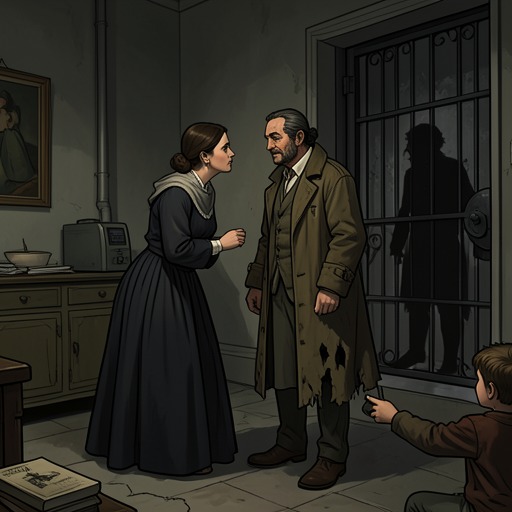
Ghismonda’s secret passage
The DecameronGhismonda’s secret passage is a concealed route from the rooms of the prince’s palace to an abandoned grotto beside it. Its forgotten stair, overgrown tunnel mouth, and carefully prepared rope turn an obsolete feature of the palace into the means by which Ghismonda and Guiscardo meet in secret. The route enables their affair, but its concealment cannot prevent discovery inside the chamber it leads to.
Location and structure
The passage joins two very different spaces. On the palace side, a private stair descends from one of the ground-floor rooms in Ghismonda’s apartment. A very strong door shuts off the stair, and so long has it gone unused that almost no one remembers it. Below, the stair opens into a grotto hewn from the rock beside the prince’s palace. Light reaches the grotto through a tunnel made through the mountain; because the grotto has been abandoned, briers and weeds have nearly blocked the tunnel’s outer mouth. The account’s footnote allows that this opening may be understood as an airshaft, emphasizing its narrow, concealed character.
The physical arrangement makes secrecy dependent on both an interior entrance and an exterior exit. The stair is hidden within the palace, while the tunnel opens beyond it through overgrowth. Neither part is an ordinary doorway used by household members: the passage has fallen out of memory, and the outer approach is almost obstructed by vegetation. Together, these features provide a route between Ghismonda’s private chamber and a secluded space outside the ordinary circulation of the palace.
Ghismonda reopens the route
Love recalls the forgotten stair to Ghismonda’s memory. To make use of it, she labors for many days with whatever tools she can command before managing to open the strong door. She then descends alone into the grotto, sees the tunnel, and sends word to Guiscardo to come that way. She also estimates the height from the tunnel mouth to the ground, giving him information needed to make the descent. The route is therefore not simply found and used: Ghismonda has to recover access to it, clear the way in, and communicate its practical details without making a confidant of anyone.
Guiscardo prepares for the route as a physical undertaking. He makes a rope with knots and loops so that he can descend and climb back up, and puts on a leather suit to protect himself from the briers. At night he goes to the tunnel mouth without letting anyone know, fastens one end of the rope to a stout tree stump growing there, and lowers himself into the grotto. The passage’s privacy depends on this practical collaboration: Ghismonda provides access and guidance inside the palace, while Guiscardo equips himself to negotiate the concealed exterior approach.
A route for repeated meetings
After Guiscardo waits in the grotto, Ghismonda feigns a desire to sleep, dismisses her women, and shuts herself alone in her chamber. She opens the hidden door and descends to meet him. The two return together to her room, where they remain for much of the day, then agree on how to conduct their love discreetly. Guiscardo goes back into the grotto; Ghismonda closes the door and rejoins her women. That night he climbs the rope, emerges at the mouth of the tunnel, and returns to his lodging.
Once he has learned the way, Guiscardo comes by it many times. The passage is thus more than a one-time escape or entrance: it supports a repeated pattern of secret visits, coordinated with the rhythms of palace life. The concealed door can be opened when Ghismonda is alone, and the tunnel allows Guiscardo to arrive and depart without being seen. Their precaution is effective for a time, but it depends on the assumption that the chamber itself is unoccupied by anyone they have not noticed.
Discovery and consequence
That assumption fails when Tancred enters Ghismonda’s chamber while she is away in her garden. He is accustomed to visiting her alone, and comes in without being seen or heard. Finding the windows shut and the bed curtains drawn, he sits at its foot, pulls the curtain over himself, and falls asleep. Ghismonda later enters, leaves her women in the garden, and opens the secret door for Guiscardo without realizing that her father is concealed in the room. The passage carries the lovers successfully from grotto to chamber; it cannot conceal what happens once they are there.
After Tancred witnesses them together, the lovers leave the chamber by their customary route, and Guiscardo returns to the grotto. Tancred slips out unseen and, that night, orders two men to seize Guiscardo as he emerges from the tunnel. The same exit that had served as the lovers’ discreet way back becomes the point at which Tancred’s order can intercept him. The passage’s failure is not that its entrance has been discovered, but that secrecy of movement cannot guarantee privacy at the destination. In the story, the forgotten architecture briefly makes the lovers’ meetings possible; the discovery in Ghismonda’s chamber turns their hidden route into part of the chain of events leading to Guiscardo’s capture.